



































What Are the Signs Your Network Has Already Been Compromised?
Most cyber attacks don’t happen in a single moment. Attackers often gain access quietly, move through systems unnoticed, and gather information...
Tailored consulting, engineering, and managed security services to meet your needs.
Discover who we are, what drives us, and how Cortrucent partners with businesses to deliver lasting security and technology success.
Explore Cortrucent’s latest insights, industry updates, and expert resources to strengthen your cybersecurity and IT strategy.
2 min read
Madison Bocchino
:
Updated on March 27, 2026
When people hear about a cyberattack, they often think first about stolen data.
But that is only part of the story.
Sometimes the bigger business problem is not what attackers take. It is what the organization suddenly cannot do. That is what makes the recent Stryker incident such an important example for business leaders. On March 11, 2026, Stryker disclosed that it had identified a cybersecurity incident affecting certain IT systems that resulted in a global disruption to the company's Microsoft environment. The company said it activated its cyber response plan, brought in external advisors, and later stated that it believed the incident had been contained and that restoration was underway.
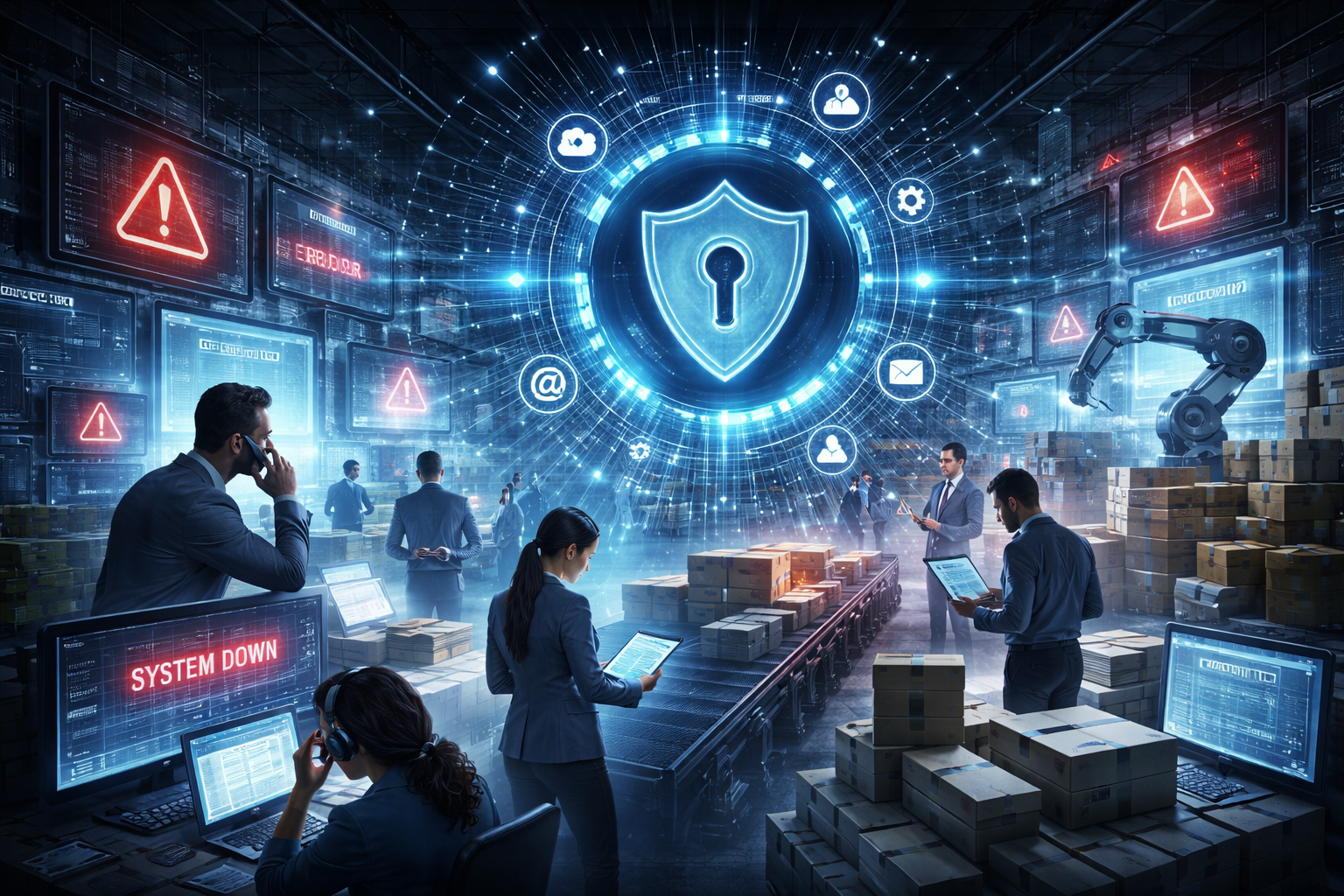
That matters because Stryker did not describe this as only a data event. The company said the incident caused disruptions and limitations in access to information systems and business applications that support parts of its operations and corporate functions. In its public updates, Stryker was even more direct, noting that the disruption affected order processing, manufacturing, and shipping.
That is the real lesson for businesses today: cyber incidents do not need to become a full scale data breach to become a serious business crisis.
Operational resilience is a company's ability to keep essential work moving during disruption and recover quickly when critical systems go down. The Stryker incident is a reminder that this is now a cybersecurity issue just as much as it is an IT or compliance issue.
When core platforms are disrupted, the impact can spread far beyond the security team. Employees may lose access to communication tools, internal workflows can stall, orders can back up, production can slow, and customer service can become harder to deliver.
This is why organizations need to stop framing cyber readiness only around breach prevention. Prevention matters, but resilience determines how much damage an incident actually causes. A company that can continue serving customers, shift to alternate workflows, and restore systems in an organized way is in a much stronger position than one that is fully dependent on uninterrupted access to a small number of platforms.
A better question is: What happens to the business if key systems become unavailable tomorrow?
That is where many organizations are more exposed than they realize. Core business functions often depend on a tightly connected stack of identity services, productivity tools, endpoint management systems, order workflows, and cloud platforms. When one of those environments is disrupted, the effects can cascade.
The Stryker story is a reminder that continuity planning cannot be a box checking exercise. Businesses need to understand which systems are truly mission critical, what breaks when those systems are unavailable, and what fallback processes exist when employees lose access.
The first lesson is that resilience has to be designed into operations. Companies need to identify which systems are essential to keeping the business moving and determine how to continue functioning if those systems go offline.
The second lesson is that continuity plans need to be practical, not theoretical. If employees lose access to core tools, teams should already know what backup processes exist, who makes decisions, how customers are informed, and how essential work continues.
The third lesson is that restoration speed matters. Even when an incident is contained, organizations can still be left dealing with delays, backlogs, and manual workarounds for days or even weeks.
And finally, cyber resilience is not just the responsibility of the security team. Operations, IT, communications, leadership, supply chain, and customer facing teams all play a role in whether a business can absorb disruption and recover effectively.
The Stryker story is a strong reminder that the cost of a cyberattack is not always measured first in leaked records. Sometimes it is measured in delayed orders, slowed manufacturing, interrupted workflows, and the strain of restoring systems while trying to keep the business running.
In today's environment, the question is not only whether a company can prevent every incident.
It is whether it can still operate when one happens.
Most cyber attacks don’t happen in a single moment. Attackers often gain access quietly, move through systems unnoticed, and gather information...
Healthcare organizations are among the most targeted industries for cyber attacks. From hospitals and clinics to private practices and healthcare...
Artificial intelligence is rapidly transforming the way businesses operate. From ChatGPT and Microsoft Copilot to AI-driven automation and analytics,...